Thursday, 22 October 2015

A word from our Scottish colleague:


International Akoranga o Naenae...

Thinking back to when I arrived in New Zealand 7 months ago,  education was the last thing on my mind. Having taught for nearly 16 years in the same school, my sole focus was to find my two children a fabulous school for 12 months, and luckily, have a year to myself! I was off the education treadmill as it had become, a time to refresh and recharge and hopefully find the original passion I used to feel for teaching. As the weeks went on and my kids came home with numerous stories about how different their school, classmates and teachers were, I became intrigued: What was so different? My shy, reserved children had settled really quickly and were highly motivated about their learning.


I inquired about volunteering to get a taste of Kiwi education and met Kelly Layton who, over a cup of tea,  gave me a quick overview of Akoranga o Naenae; even the name of the school had me fascinated. So I turned up that first Friday expecting to help out in a regular class. Instead I was thrown into something completely different! I had so many questions: how could one whole day (20% of a child’s week) be devoted to learning about one thing? What about accountability? How would they measure the impact of their teaching? What about literacy and numeracy?


My first visit was really scary, but exciting. I hadn’t taught or been in a school for months and this wasn’t the environment I was used to! ‘Active Learning’ – I knew all about that didn’t I? I had been planning lessons for years encouraging my students to be active learners. I quickly realised I had a lot to learn! Google Drive, Infinity Learning Maps – I hadn’t used any of these tools before. Bring it on!


After a few hours observing the students and the slick collaboration of the team,  I just thought WOW! Lots of thoughts and ideas were running through my brain. I had been inspired beyond words, which hadn’t happened in a long time. What Kelly, Clare and Natasha were doing was truly incredible. They totally believed in their school and approached it with so much positive energy that I couldn’t wait for the next week!


I’ve now been volunteering every Friday for months and have experienced both rounds of AoN. I have seen the teachers reflect on their own practice and evolve their programme for round 2 with Kerry now part of the team; I have seen how much more confident they are second time around and how much quicker the children seem to lead their own learning. I have learned so much…. about myself, my teaching, even the way I act around my own children.


Although I knew what Active Learning was and hoped my lessons were active, having it broken down into the 6 traits and their success criteria was totally enlightening. I was good at questioning my students, I gave them learning intentions, teased success criteria from them, helped them reflect on their learning, my lessons were fun but I still had some lethargic, unmotivated kids. Then it hit me… I still controlled the content, the pace and how challenging it was. The children at AoN were really motivated and engaged – why? THEY had a choice and they made the decisions. They knew the success criteria and were able to lead their project in their own time and way.   


As with a lot of teachers I like control; I like things to be organised and I have an almost compulsive desire to be in ‘the driving seat’. I now understand how detrimental that can be. It’s all about balance. As a teacher it’s about giving them a purpose to their learning; making life connections in every lesson and providing them with the skills of ‘how’ to learn, make decisions and solve problems!
An important lesson I have learned is to focus on the journey, how they’ve got there is more important than using the product as an indicator of their success. They use questions to connect their learning. What do they already know? How can they connect this learning to other contexts? Link the purpose of the other things they’ve learned and reflect, reflect, reflect. The team continually refer to themselves as learners, continually making links to the traits  and showing the students how they reflect and make connections. Reiterating the ‘common language’.


Creativity and the use of technology features hugely in their day. I liked how the planning for the next week was emailed to the students giving them opportunity to prepare and be focused. Nothing was a surprise. I noticed as the weeks went on more children seemed to access and view the daily planning. Was attending AoN changing behaviours?


The students are encouraged to use their IT skills to develop their project, whether exploring the web, emailing, blogging or creating a slide show. They are given the freedom and TIME to use technology for independent inquiry. I started to see the connections between different areas of learning, the interdisciplinary links; communication on the telephone, spelling, grammar and punctuation in emails inviting or thanking people, organising times to visit experts. I loved how the day was split up and planned, and breaking from the traditional method of time slots took away any barriers.  Using alliterative words, Activate, Action, Analyse and Afterwards made it easy for the students to remember and summed up exactly what being achieved!


Okay… with all thoughts of having a year away from education, I am more inspired than ever to get back into the classroom. I am really curious to see how this approach would work in a Scottish primary school and how I would go about implementing it.


Involving learners in their own learning seems pretty straightforward and is at the heart of Scottish Education and our ‘Journey to Excellence’. HMiE declares that a school will be rated excellent, where among many things -
  •         their learners have choices
  •         can demonstrate links with previous learning
  •         solve problems
  •         question
  •         show perseverance
  •         can use their learning out of the classroom
  •         are supported in their reflection
  •         are leaders in their own learning


Isn’t this exactly what AoN is all about? Where the teachers are role models reflecting on their own practice AND feedback from their students about how successful their lessons have been.
I am really excited to share this experience with my colleagues and our cluster network of schools and hopefully start identifying children who would really benefit from an AoN type approach, being able to make their own choices and control their learning, but with a guided framework. Letting them explore their passions and possibly finding some experts we didn’t know about!


Reflecting on my own classroom practice has made me think, I need to
·         give more ownership of learning to my students
·         make learning more challenging
·         including more creative and investigative opportunities
·         give the students the freedom to use technology to learn
·         make sure I fully demonstrate links with other areas of the curriculum
·         think about the questioning of my students and how this will lead to their own inquiry
·         give lots of time for reflection and not just use it as a plenary tool
·         allow my students some time to decide what and how they want to learn, but with responsibility of how they will demonstrate it
·         use my community more, tap into all the experts we are sure to have around our school and surrounding area, teachers don’t know everything!

Clearly there will be barriers, but I am an active learner and I will show resilience. I’ll let you know how it goes!!

Friday, 16 October 2015

The chance to try again...The AoN satellite school By Natasha

How often do we give our students the chance to try again? How often do we give ourselves the chance to try again? We often talk about reflection being an incredibly powerful component to learning but how often do we create an environment where reflections can be acted upon? 


Source: http://adultrunaway.tumblr.com/post/77406653992

Having worked with Kelly and Clare at Akoranga o Naenae in Term 1 and Term 2, this term I was excited to take my new learning back into class and act upon my reflections. In the AoN 'satellite school' there would be some differences and some things would stay the same. 

The differences: 
  • We would be based at a school, rather than in the community.
  • A new collaboration - this time I would learn alongside my fellow year 4 teacher.
  • The students would all be from the same school but it would give 2 classes the chance to collaborate with each other.
What would stay the same: 
  • The thinking that sat behind AoN i.e. students exploring their passions around a framework of active learning. 
  • The framework - students being exposed the interests they may not have considered --> selecting a passion to focus on --> planning their project: what do they want to find out? What tools, people and places will be useful? How will they share their learning? --> sharing their learning in a way that positively impacts on others. 
  • The involvement of experts: so far we have a parent who is supporting the cooking group and next week an explorer who just returned from an expedition to Antarctica. 

Reflections in action: 

Following a similar framework has provided the chance for refinement. One example of this is around the questioning phase of the projects. Jane and I decided that the questioning phase was an important part of the research process and that having well thought out questions would provide purposeful signposts for students to keep referring back to. Students came up with a whole range of questions, some of them related to the research process e.g. Who can I contact to help me with this? How will I know if I have been successful? Other questions were around their actual passion e.g. What are some really important inventions in history? We spent some time discussing what might be the most useful way to sort these questions, torn between process-and-passion and beginning-during-end. Through talking with the students it was clear to see they had an understanding of the difference between those questions which would help them to find out information and those that were about their passion so we went with beginning, during, end. The students found this grid (tweeted by  ) to be a useful tool for developing their questioning skills...


We also recognised that you don't always know what you want to find out at the start. Questioning is an ongoing part of finding out and new questions arise as you find out more. We want to encourage students to document their pivotal questions throughout the process. 

Giving our students the chance to act on their reflections: 

Going through the process again made me reflect on the value of allowing students to go through a process for a second time (even a third or forth). 

At the start of the year my class had a go at Mr e's line art. The complexity of the task meant they had to go again and again and again. More recently we did the star challenge. Again the high level of challenge meant that students made 6 or 7 attempts reflecting, adapting and modifying as they went along. Collaborative and reflective discussions were happening all around the room...

Student 1 - I think that line looks too long
Student 2 - Can you go back to the instructions and find where you made the mistake? Then have another go. 

Making the most the chance to try again...

In situations where this has had the most impact there have been some commonalities:

In both of the above cases, students had the chance to act on their reflections almost instantly. Does this mean it always needs to be instant? Perhaps not... but then we would need to help them make the connections so they can use their reflections. 

Collaboration: Working alongside somebody with a common purpose. 


I think the same could be said for students? 

High level of challenge: if the task is something that can be completed easily surely this removes the motivation to try again? 

Having the chance to use my learning from AoN, by going through a similar process; allowing the students to lead their learning, whilst explicitly teaching the skills of being an active learner, has given me the chance to put reflections into action! It's also got me thinking about how I make sure my students get the chance to use their reflections too! 


Monday, 31 August 2015

Why Would You? Kerry


  As the day of arrival for round 2 of our AoN students drew closer, I was excited, nervous and grateful to have the opportunity to be part of something I'd heard so much about from students, their whānau,Twitter posts and conversations amongst my colleagues.

I wondered  where I would  fit in and what I could  bring to this already highly successful team and evolving model?


 I'm still trying to figure the answer to this question out as we approach our  fifth week of working with our new group of students.What I know is that we  have a wonderful group of learners, who are connecting, risk taking, rising to the challenge of new learning and who have chosen and are now  beginning to explore their passion projects.Wow! what a wide range of diverse interest these active learners have ! It is very interesting and exciting..

Last term a student from AoN connected with me via e-mail  asking for help with her passion project. I was fortunate to spend the day with the students, leaders and whānau of AoN. I felt inspired and left reflecting on the students' high level of confidence and engagement in their learning, along with the passion and enthusiasm with which they had shared their knowledge with me.
 This struck home - as my own learning has been driven by passion, creativity and resilience.
I believe these traits underpin my achievements and richest experiences in life.
Reflecting on my teaching practice, I've  realised that this thread of creativity, passion and resilience runs through my most effective teaching moments and is when student engagement has been high.

  My teaching background is varied.  I've taught at all levels and worked alongside many
wonderful teachers and leaders.  Much of my teaching has been focused around The Arts and I have a particular interest in supporting all students to develop their creative potential. I also understand that there are many ways to be creative and 'creativity ' is not exclusive to, but rather inclusive of The Arts.


  I have been reading with interest the changes in education and in particular  the 'shift to student led learning and the need for teachers to "trust that students know what they need to learn", and for us to "let go" of the need to control all aspects of a student's learning.

Personally, I like knowing exactly what is expected of me and what I need to 'do,' so when things change and appear unclear it does get  'a little scary, uncomfortable and I need to remind myself to trust.

  My perspective in teaching comes from 15 years plus of part-time teaching and working in and out of other teachers' classes. Change is part of everyday life. Working like this has taught me a lot about 'how to teach' rather that 'what you teach' and how to learn and work alongside students and other teachers.  As I continue to develop my understanding of Active Learning traits and Future Focused Education with a shift from 'acquiring lots of knowledge' to 'developing a set of transferable skills' my thoughts are affirmed.


I've been viewing Ted Talks by John Hattie about "Why So Many Of Our Schools Are So Successful?" and by Grant Lichtman "What 60 Schools Can Tell Us About Teaching 21st Century Skills" , and I've learnt a new word "Cognitosphere". I've been learning about "Growth mindset vs fixed" and  I've just read an interesting article online by Barbara Challenger called "Building The Future Today: The Need For Creativity In Education".  She talks about "...the future..." being  "...shaped by the creative talents of inspired well educated children".  She goes on to define creativity as "...a process of having original ideas that have value".  Involving "...the imagination, vision, taking risks and being prepared to be wrong"
.


And so
    as I join the team at AoN 
        I wonder....


  • What will the creative process look like at AoN where students are leading, making their own decisions about their learning and are following a passion?
  • What is the link between raising student achievement and creativity?
  • How will students transfer skills learnt at  AoN between communities ( school, home etc..)and will we see this reflected in raised student achievement?
  • Will the students get what they need from the active learning model vs a curriculum led one?
  • What will it be like to teach in a supportive co-teaching environment instead of alone?
This is very exciting...
        So many questions
                So much to read...
                        So much to learn...
                              And now to answer, 
                                        " why would you?
                                                
Simply another question...
                         "Why would you not?"

Thursday, 27 August 2015

So ... Did It Work?!


This is a period of transition for us here at Akoranga o Naenae, as we finish our evaluations of Round 1 and begin anew with 48 eager students for Round 2.

As we said at the beginning, Akoranga o Naenae is based on a hunch, with the main principles well researched.  Now we wanted to determine whether or not AoN has proven itself effective.  Our chief supporters, our network leaders, are realistic and experienced people.  They know that change takes time, and have not put unfair expectations on us.  However, we always knew that we would have to prove ourselves pretty quickly to ensure that we could continue AoN.  As such, the evaluations from Round 1 have been much anticipated (particularly from data geeks like me!) Keep in mind we had (only) 14 days with our learners. 

As with most things at Akoranga o Naenae, when considering methods for collecting evaluations, we tried to think outside the box.  As there was not one tool that was going to give us all the information we needed, we used a variety of tools, and we asked everyone who had been involved for their perspective.  These included self-assessment, questionnaires, video recordings, and reflective discussions.

We started with the most important players - the students.  Way back at the

IMG_1021.JPG
Start of Round 1
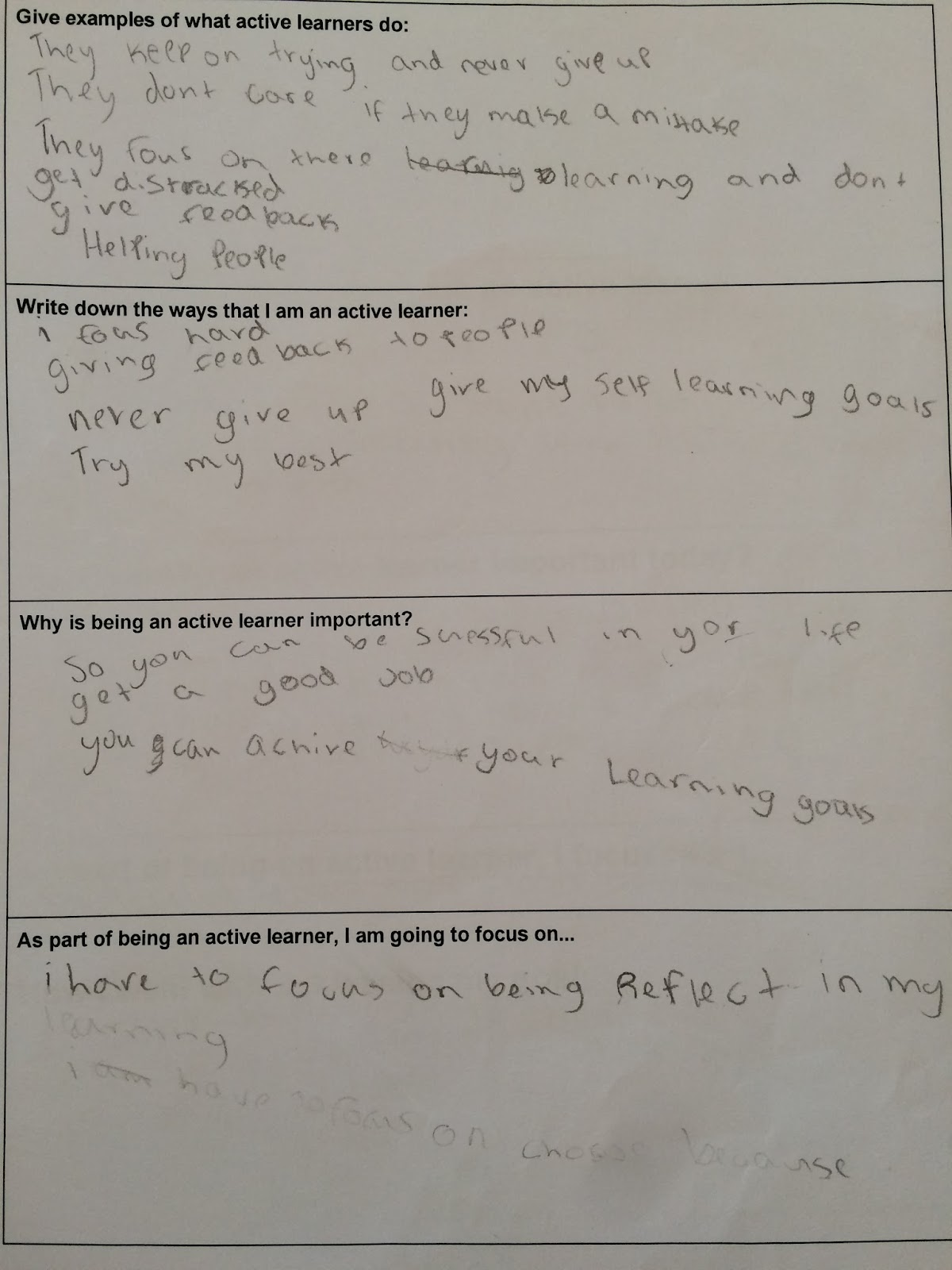
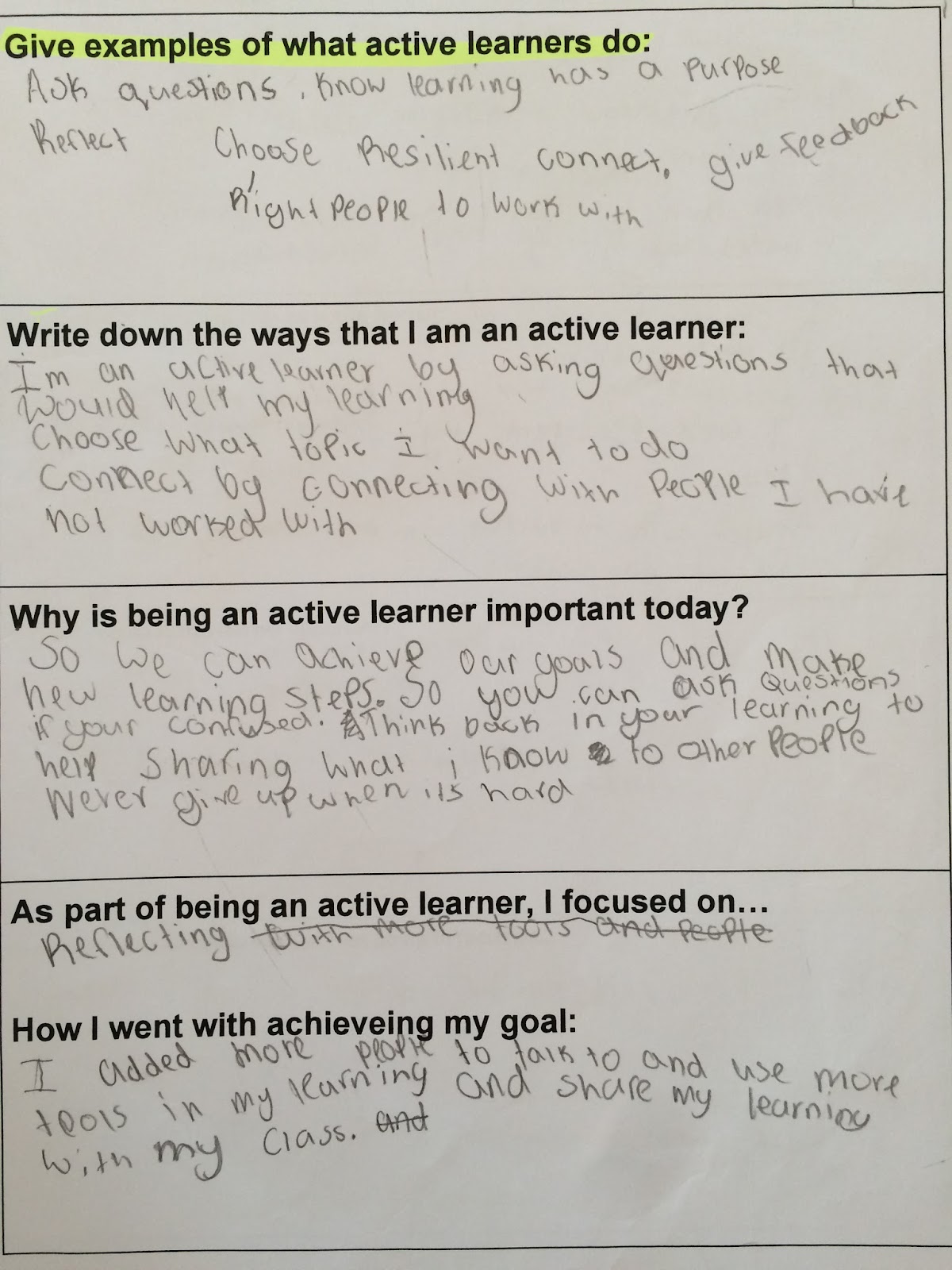
beginning of AoN, we had asked the students to do a self-assessment, indicating their knowledge of the active learner traits, and their understanding of when they show these traits themselves.  We then asked them to complete the same self-assessment at the end of AoN.  By turning their answers into numerical ratings, based on a pre-determined criteria, we could compare the beginning and end data.  This showed that:

  • the students were more able to articulate what active learning was after working with us at AoN for 14 weeks (total score at the end of 81 points, compared with 49 points at the beginning) 

= 65% improvement


  • the students showed an improvement in their ability to describe when they are active learners in real life situations (79 points at the end; 47 at the beginning)

IMG_1022.JPG
End of Round 1
= 68% improvement


  • the students were able to explain why active learning is important and relevant to their lives (especially now, not just in the future).  This was the area that we knew the students found the most difficult, and we had worked hard on, so we were pleased to see a total of 51 points at the end of AoN, compared with 33 points at the beginning

= 54% improvement


These three key points showed us that the learning had been effective for many of our 48 learners.  Bearing in mind that many, if not most, of these kids are priority learners, whatever impact we had (positive or negative) was always going to be important.  We were pretty excited by this results, and proud of what we all had achieved over 14 days.  It gives us more confidence to hope (as we always have) that AoN might end up being one of the things that leads to improved academic success for some of these students.  We have anecdotal evidence from several kids, families, and leaders to say that they have seen just that.  Kids telling us about how they used not to be at the National Standard, and now they are; parents describing their child as 'sky rocketing' at school; and leaders collating data on their eight AoN students, showing significant improvements in reading, writing, and maths.


We used Infinity Learning Maps as an assessment tool throughout our time at AoN, and these provided us with very interesting data, too:

Learning maps #1, #2 and #3
  • as students became more active in their learning, the number of connections with people outside of their normal 'bubble' became much larger.  This then decreased as the students became more purposeful/specific in their questioning
  • students came to better understand how technology can help them connect and learn
  • the students became more aware that learning happens everywhere, not just in a classroom

Students' survey
Our third method of collecting student evaluations was through a survey.  The main themes were:
  • the students loved getting to know others from the network and working with them
  • they appreciated what the community space could offer
  • they really enjoyed the food we had on our Learning Maps days!!


We also asked our schools' leaders for their evaluations of AoN, with a questionnaire targeting specific areas of interest to us, as well as giving them room to add other thoughts.  This is a small sample size, with only six schools in our network, but their comments were thoughtful, considered, and helpful to us.  These included:

  • a concern that the 'off-site' nature of AoN appears to imply that schools are not able to cater for their priority learners (which we know is not the case, but those making such an inference may not realise that)
  • the difficulties with transferring the active learning ideas from AoN into school classrooms, despite a variety of efforts
  • the workload on the teachers at AoN, particularly at the beginning and in the set-up phase
  • the effectiveness of connections with whanau
  • the increased "student agency" that was seen in some AoN students back at their schools (for example, at ine school some students starting a coding club. At a different school, students coaching younger sports teams)
  • the benefit of having another 'shared purpose' amongst the network schools


Some the Leaders Questions of


When asking whanau for their evaluations, we mostly used video recordings to capture their thoughts about AoN, and its impact for their child.  These resulted in some very heart-warming moments, and some honest truths.  The highlights were:
  • hearing that students had developed their own 'drive' to learn
  • confirming the fact that the students were motivated by the power of choice
  • believing that AoN had contributed to an improvement in academic success at school

Some of the teacher questions
The next group we wanted to get evaluations from was the teachers of these students back in their own schools.  We have been really interested in how the skills they had been developing at AoN could transfer back to other areas of the students' lives.  We asked teachers to fill in a quick online survey.  The teachers who did so gave us some useful feedback, including:
that some students clearly understood the link between their learning at AoN and school, while others did not

  • the enjoyment that most students got by learning about their passion
  • that we have not made clear enough to some teachers the basis for AoN 

Lastly, Natasha, Kelly, and I did our own evaluation.  We knew there were a lot of positives that would come from this, as we had been there each day, seeing the change in the students.  These positives were tempered with some points for future improvement.  We are active learners who reflect!  The main themes were:

AoN teacher evaluation
  • the difficulty in striking the right balance between too much and not enough communication with teachers and leaders
  • the tensions caused by some people in the network being more engaged than others
  • the difficulty with wifi!
  • the high workload
  • the incredible professional development that AoN was for each of us
  • the benefits of AoN being held in a community space
  • the significant observable changes in the learners from Day 1 to Day 14


So, overall, did AoN 'work'?  Did the 14 days we spent together make a difference to these students?  Did it help them to build skills and understanding about how they can enhance the way they learn in all areas of their lives?  It sure did!  In the words of one of our students:  "Akoranga o Naenae changed my life".


As active learners ourselves, we're not stopping there!
We have been cogitating over all of this evaluation data, considering our next steps, and contemplating about how what we've learnt so far can help us in Round 2 and beyond.  The main points we will be working on are:
  • the possibility of co-constructing success criteria for our Active Learning trait assessments with students,
  • the purpose of each planning, assessment, and evaluation tool, and how to best use these,
  • how we can streamline the whole time-frame (and we have to, as Round 2 is only 12 weeks!), and ...
  • continuing to try to find ways to make transference between AoN and schools understandable and practicable for leaders, teachers, and students


How do you feel about AoN finishing?


This is just a snippet of what we wanted to say.  If you have any questions or want further information, please contact us.  We'd be really excited to talk about these evaluations in more depth.

Friday, 7 August 2015

Reflections on Round 1 - Natasha

My reflections on my experiences at AoN may take a slightly different angle than Kelly and Clare’s, as from next Term I will no longer be going out of my classroom to The River of Life Centre. I will continue my learning back at school with what we have termed the 'AoN satellite class'. On a Friday, I will co-teach with another Year 4 teacher back at my home school, with students exploring a passion, whilst developing the skills of active learning. We see this as a wonderful opportunity to track the learning dispositions of students who have been to AoN (of whom I have 3 in my class) over a longer period of time. I will continue to post my reflections on this blog and will continue to learn alongside Kelly, Clare and now Kerry. 


If I look back to my wonderings at the start of AoN, it really is exciting to see how much has happened in that space of time. Working in this environment allowed me to explore my thinking with the advantage of 2 other perspectives, provided by Kelly and Clare. I don't believe that without the collaborative planning, challenging of ideas and rigorous discussions I would have been at the place I am now at in terms of my thinking. Working in this collaborative way has proved to be a first class professional learning experience!

Now that I am ready to continue to take my learning back into my classroom, it seems like the ideal time to take stock of where I'm at...

At the start of AoN I had this wondering: 

What might teaching, planning and assessment look like if the Key Competencies were used as a starting point, rather than a by-product or an add on to other learning intentions? What if the Key Competencies were the main road instead of a side street? The Key Competencies go across all learning areas but what does this look like in practice?

Exploring this wondering through the lens of active learning, rather than Key 
Competencies was not a problem as there was lots of overlap. In terms of teaching and planning, much of our explicit teaching in the initial stages was around the six active learning traits. Kelly, Clare and I spent a lot of time prior to starting with the students discussing and debating the active learner traits. After brainstorming, sorting, grouping and re-grouping we agreed on six traits. We agreed that active learners: question, choose, reflect, are resilient, know learning has a purpose and connect. From there we unpacked what each of these traits looked like in practice, which gave us our success criteria.

Once we had a clear understanding we were ready to design some explicit teaching around the traits with the students. Initially we spent some time helping them to understand what each of the traits looked like in practice. We then gave them some specific examples of what it would like if they were using displaying these traits. Following this, students came up with examples of where they were using or could be using the traits at home, at school or anywhere in their lives.

In the first few weeks of AoN we spent a lot of time discussing and modelling these traits to, with and by the students. Many of the learning opportunities were designed in a way that students could specifically focus on these traits. This meant that when students embarked on their passion projects they had a thorough understanding of the active learner traits and these were a pivotal part of all of our learning. The passion projects provided the context for students to continue to develop and apply their skills in active learning. This started me thinking about how at the start of the year we spend time focusing on Key Competencies with our class and then they take a back seat so that we can get on with the ‘real’ learning. At AoN, the active learner traits were the starting point and the students' passions provided the context. They were not an 'instead of', but an integral part of the learning.


What was it about the set up that enabled active learner traits to take centre stage?  
Firstly, all of us valued the active learner traits. We all believed that if students could be active in their learning this would make a difference to their engagement and in time, to achievement.
Secondly, in our Active Learner success criteria, we had developed a clear framework which we constantly referred to in our planning, discussions and evaluations.
Thirdly, our planning framework wasn’t structured by curriculum areas but by student need in terms of how they would learn about active learning and how to BE an active learner. The day was divided into a 4 parts; a session that was more teacher directed with explicit teaching around the traits; a session where students would use the traits to explore their passion; a session where students reflected on their learning using a given framework; and a session where students had chance to think about how they would use and continue their learning throughout the week. This of course doesn’t mean that structuring a day using curriculum areas is exclusive to teaching students about active learning. Guy Claxton’s split screen approach whereby learning intentions are twofold and students learn both ‘about’ (knowledge) and learn to (skill based) could be one framework for ensuring active learning traits are central even within a day structured around curriculum areas.

In terms of assessment we used a range of tools to gather information on how students were developing their skills around being an active learner: 

Learning maps - a visual tool whereby students drew what their learning environment looked like. 


Active learner self assessment


IMG_1022.JPG

Information gathered from students and Whānau gave us a rich insight into how students were transferring their active learner skills in various contexts and what they had taken from the experience. 

Another wondering I had was: If the skills involved in being an active learner are explicitly taught and valued will this transfer in all contexts, i.e. from AoN to home and school. Are there instances where this is or is not the case and what are the key factors at play in these instances? 

There were many instances where skill transference was evident. This was shown in different evaluative tools including learning maps, self assessments and perhaps most powerfully in video clips of students and Whānau

There were some factors that we believe enhanced the transference of the active learner traits:
Attendance: In some cases, where students were absent for some of the sessions, they found it difficult to catch up. Given that AoN happened once a week, missing sessions meant that it could feel like they were away for a long period of time.
Consistency of approach in all places; at home, at their home school, at AoN: Where teachers were invested in AoN and the thinking behind teaching active learner skills; and alongside this parents were also using the language of active learning, we found a higher degree of transference.

In stepping into the unknown I had this wondering too: What are the benefits and challenges of working in a collaborative environment?

For me this was my first experience of teaching in the same space as two other teachers. In speaking to others who have co-taught, I know that it isn’t always as harmonious as what I am fortunate enough to have experienced and this got me thinking about why this was:

  • Kelly, Clare and I all have differences in terms of our personalities however our philosophies around teaching and learning are closely aligned.
  • Where there were disagreements: it was usually around how we were going to go about something rather than why. We always challenged the point and at no point the person.
  • We were open and honest about how we were feeling: in the set up stages of AoN we spoke about the importance of being open and honest and I feel that at all times we managed to do so.
  • Finally and possibly most importantly we really valued and respected each other's practice, thoughts and feelings. Also, we were all totally open to learning from each other.
Given the above reflections, do I believe co-teaching could work effectively where there are differences in teaching philosophies? I see it as a continuum. If there are points of difference I don’t believe that this would be counteractive and in fact may make for some great discussions which could ensure clarity of thinking. For me the bigger things would have to be aligned; those are around the importance of student agency, research driven and research influencing practice, and in terms of the co-teacher - a real openness to learning would be pivotal.   

The last term and a half has been an incredible learning experience. It has broadened my horizons in terms of who I can connect with and learn with. The opportunity to collaborate in designing learning opportunities with students where the skills of learning are explicitly taught, valued and assessed has been inspiring. I cannot wait to continue the learning and to see how we progress with our 'AoN satellite class' and